New Microsoft browser not terrible

Modern web development

Microsoft gave us tech bloggers a sneak peak at their new IE8 web browser the other day.

On the whole I like it. In several areas, IE8 catches up in features to other modern browsers. In other areas, it introduce a few new tricks other browsers could learn from.

IE8 does still retain the bizarre menu button placement introduced by IE7, as well as the generally Vista-ish (read tacky) look and feel of the chrome. This is probably enough to keep me personally from using it. What can you do. The important thing, the really important thing, however, is that a lot of other people start using it.

As far as functionality IE8 is one big step forward for Microsoft. And IE8 should be a good thing for the web. Some people will complain that the browser does introduce a number of new proprietary/non-standard features but you don’t have to use them. On the contrary, IE8 looks to be much more compatible where it counts as far as CSS and fundamental webstandards compatibility.

Modern versions of firefox, safari, opera are really great browsers and have been for years. If you’ve got one of these you are doing just fine. Nonetheless, stubbornly millions of people and far too many IT departments are still stuck way back on IE6. The F&*#&ckers. This is a problem. Maybe a problem only Microsoft can fix.

So it’s great news than, for the first time in many years, MS will have a browser worth using. How they plan to convert all those old IE6 & 7 users I don’t know (the process hasn’t gone so well for Vista you know). But if it can be done, if IE8, Firefox, and Safari can become the new baseline for the desktop web, than we could really get back to building some wonderful things. And web designers everywhere would just have to find something else to spend their time swearing about.

You can play with IE8 beta2 yourself if you like.

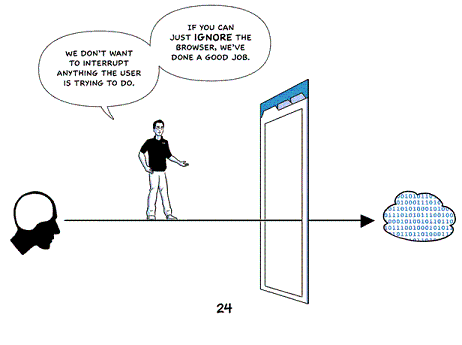
graphic: Modern Web development [circa 2006], Alan “IE users must die” Foreman

Posted in Archive, microsoft | Tagged , , , | 5 Comments

Planning Enterprise 2.0 seminars in Toronto

Jevon Macdonald and I are thinking to organize a new Enterprise 2.0 event in Toronto towards the end of October. It’s been a while since there has been one in the city, and a lot has been happening in the field. We’d like to structure this event as an intensive how-to session focused on workshops and repeatable case studies and outcomes for medium to large organizations.

This is just a pre-announcement and heads up. If you have an interest in a) teaming up with us on this event 2) presenting a case study, seminar or keynote 3) sponsorship opportunities for such an event, it would be good to drop either Jevon or I an email.

More to come.

Posted in Archive, enterprise 2.0, events | Tagged , | 2 Comments

Asking CIOs the wrong questions about Enterprise 2.0

Why aren’t corporate CIO’s flocking to blogs, wikis and other social tools as fast as you’d think? Nearly two thirds of CIO’s in a recent survey responded that they have no plans to introduce “blogs” or “wikis”. And (cough) “virtual worlds” scored even lower. ITWorld Canada interviewed me the other day on this subject. Here’s an excerpt of what I had to say:

But according to tech blogger and Firestoker co-founder Thomas Purves, the problem might be finding the right tools to use. Virility doesn’t work in the enterprise space as easily as it does on the open Web, said Purves. “If you have firewalls in the way, what one business is using internally, the business right next door to them has no idea…what’s going on there or what value they might be getting out of it. So it’s really hard for ideas, when they do work, to spread,” he said. “I think also some of the best tools are coming out of companies who aren’t the established IT providers…smaller startups who don’t have the distribution and the marketing reach necessary to get their story out there.”

Another obstacle may be the tools themselves, added Purves. “It’s been really slow for businesses to discover some of the values of social technology, but at the same time, a lot of social technology providers have had a tough time marketing to business or even necessarily adopting their products ideally for business as opposed to a consumer environment.”

“On the consumer side, blogs have definitely been here for a while and have been used a lot, but on the business side, not a lot of companies are doing it. I see a lot more companies using blogs internally, for maybe their collaboration tools or for their projects, but not necessarily externally communicating to their customers or their clients,” said Abramovitch.

“Blogs and wikis were version 1.0 of Web 2.0,” said Purves. “They were like direct, ‘Let’s take a few tools that have worked for Wikipedia with the blogosphere and let’s just bring them straight into the enterprise.’ I think you have to do a little bit more work than that to make tools that really work in a business environment.”

…According to Purves, online collaboration tools should be a top consideration. “Tools that empower employees and let the leadership emerge within organizations is going to be important.”…

“Inevitably, in organizations, you’re working on a project that someone was working on three years ago and you just had no idea. There’s so much reinventing the wheel and so many resources are trapped within people’s heads. Unless you have some of these social tools to expose knowledge that’s out there and get it exchanged, you don’t necessarily have those rich interactions,” said Purves.

More and the full article here: Canadian CIOs shun blogs, wikis and virtual worlds

There is whole other subtext going on here too that I should get around to doing a separate post about “Why asking CIOs about Enterprise 2.0 can be like asking dinosaurs about meteorites”.

Posted in Archive, enterprise 2.0, enterprise2.0 | Tagged , , | Leave a comment