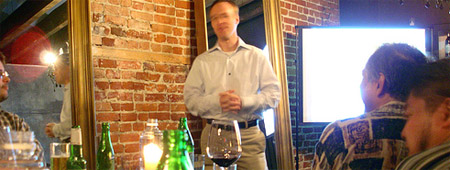
 Microsoft introduces Vista to area bloggers, Nov. 2006
“Microsoft Corp. shares fell as much as 2.7 percent on Friday, their biggest drop in nine months, after Chief Executive Steve Ballmer said analysts’ forecasts for fiscal 2008 revenue for Windows Vista were “overly aggressive.” Microsoft shares tumble on CEO comments -CNNMoney
“A new study by Jupiter Research shows that European music executives are becoming increasingly disenchanted with DRM. According to the report… Nearly two-thirds—62 percent—feel that eliminating DRM would boost the popularity of online music sales.” European music execs no fans of DRM either – Ars Technica
“Windows Vista includes an array of “features” that you don’t want. These features will make your computer less reliable and less secure. They’ll make your computer less stable and run slower. They will cause technical support problems. They may even require you to upgrade some of your peripheral hardware and existing software. And these features won’t do anything useful. In fact, they’re working against you. They’re digital rights management (DRM) features built into Vista at the behest of the entertainment industry.
And you don’t get to refuse them.” – DRM in Windows Vista Bruce Schneier
You have to feel sorry for Microsoft. At the time, those dark days of 2002, it really looked like it would go the other way. And by this I mean DRM, and “trusted†computing.
Five years ago Microsoft made a big bet on DRM. Billions were invested in a new OS built from the ground up around DRM.
This bet has turned out to be wrong.
But back then, the content industry could put the toothpaste back in the tube. Napster had been shut down, kazaa was on the run, the DMCA was ascendant, and the new promise of Trusted Computing (a misnomer if there ever was one) seemed to be promising a heavily-managed future of grinding inevitability. This future promised that that the desktop and every edge device would finally be locked down. Media companies would be able to finally, “rightfully” charge for even thinking about consuming their media.
Big It would love Trusted Computing, finally a way to reliably and thoroughly lock down the corporate desktop and properly “manage” the computing activities of all those troublesome “users” they are forced to put up with.
Meanwhile we have Vista, a platform that is designed at it’s very core to be anti-user. With Vista, users are the enemy. A locked down driver model, content “protection” features you can’t turn off, and a philosophy of questioning the user’s actions at every turn. (these features have been hidden for your protection, are you sure you want to do that? are you really really sure?)
But it didn’t turn out that way. Microsoft in lagging so long to introduce Vista, completely missed the boat on the Youtube/Wikinomics revolution. The users won. The open and peer-production model won. It turns out users want to use their computers. Sometimes in fantastic ways you could never have predicted.
2007 will be the year the music industry turns away from failed experiment that was DRM. It will take a few years longer I imagine but the movie industry (still new at digital distribution) will follow as well. Leaving vista high and dry.
In the corporate space the same is happening. Enterprise2.0 and software as a service are putting Big IT back in it’s place. All along Microsoft has been listening to the wrong customer the Big IT departments and not to USERS.
The next big change in corporate productivity is not coming from locking down users. The future of IT is not about preventing what applications users can choose to run and when or what devices they are and aren’t “trusted” to plug into their machine.
Microsoft: If a business can’t trust it’s own people, who can they trust?
I’ll answer the question this far, if a business can’t trust it’s own people, their old operating system isn’t their biggest problem.
No, the next revolution in business productivity comes from empowering *people*, and not Big IT. The next revolution comes from embracing emergent uses of tools and a default status of “openness” not the other way around. Port 80 has set us free [port 80 is used by webbrowsers to access the greater internet and the one loophole left necessarily, grudgingly, open in every corporate firewall].
What will keep Microsoft’s OS division going for now is simply it’s enormous market inertia and an unfortunate lack of breadth in other choices (leading candidates: WinXP, MacOS, Linux). But another 5 years is a long time for Microsoft to try and coast.
Meanwhile those who know, and those who are tied to corporate IT have switched to Mac already. It was the MacBookPro and Apple’s switch to powerful (and finally equivalent/better) x86 hardware that did it. Try going to a tech or blogger conference and every single person sitting comfortably ensconced behind the glowing Apple logo of their MacBooks.
Apple is too a closed platform (more closed on the hardware level than even Vista), but at least it’s a closed platform that puts it’s users needs (for the most part) ahead of the needs of the record industry or any other third parties.
This shift to apple by the world’s bloggers is a signal. Unless Microsoft recovers, big changes are coming.
People once said that AMD chips would never be accepted in the enterprise or accepted to be sold a stalwart Intel-only shop like Dell. They said Apple would never abandon their distinction PowerPC architecture but they did, they went Intel (with a vengeance). Now on x86, apple is just a word away from blowing the OS market wide-open.
What will happen next, and this will be the downfall that DRM started, is that with a word, Mr. Jobs and Mr. Dell will sign one piece of paper. And license Mac OS to Dell. I don’t know when, but it will happen.
And this will be the downfall of the Microsoft hegemony. And if that alone doesn’t do it, are you ready for the GoogleOS?
for the meantime though, you can get started on Mac OS right here.
# Thomas Purves is a software entrepreneur, and long-time Windows users living in Toronto. He, honestly, harbors Microsoft no ill-will and hopes the Vista debacle is only a wake-up call, and that they come roaring back with a truly great and pro-user revision in short order (the Windows2000 to Vista’s WindowsMe). The author would also like to personally thank the Vista team for fixing search and killing off the XP search dog. For this at least, they have his undying gratitude.
# The comments section welcomes your flames here: