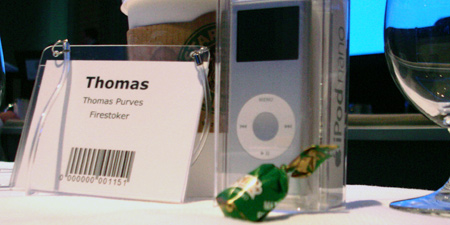
Rather than (only) being a vendor pitchfest, I am genuinely surprised by the content quality of the office 2.0 conference so far. And that’s not just the free iPod talking. Over the next two days I’ll be posting on some of the insights coming out of the conference.
# Esther Dyson, memorable quotes
– “[the future isn’t just] taking MS Office and sticking it up in the skyâ€
– it’s got to be about activity management, work process innovation and collaboration
– the key questions are not just working on a document together but to track status, where are things in the process? Who has seen it? “collaboration needs to be about verbs†not static nouns of documents
– on wiki’s: are like an empty room for collaboration, it does not give enough guidance. What we’ll see in successful tools are chairs already placed in the room: this one for the devils advocate, this one for the guy who’s writing the report..
#Andrew McAfee
– We’re only at the beginning of the beginning of office/enterprise 2.0
– Most tools provide only the suggestion of workflow (we need chairs)
– Web/office 2.0 takes conversations that were once stuck in channels (voice email) and lets those channels stay open and build to something
Users :
– Are social (something that we underestimated and surprised us with web2.0
– Busy (self explanatory)
– Biased (endowment effect, people overweight by 3x what they already have and underweight the value of new things by 3x. The 9x problem: when rolling out a new product, it needs to be perceptively 10x better than what it replaces to have any guarantee of adoption)
– Varied (uses are not all built the same)
– Willing to “speak in public†(a big one) conversations are visible and persistent overtime, will people be willing to speak out in an office environment in these circumstances ? we’re still learning)
What is the key pain office 2.0 is solving for managers?
“I don’t have a good way to tap in to the knowledge capital of this company. What projects are going on? Who knows what in my company? Who is looked at by their peers as a leader in this organization?â€
# Other notes,
– it *is* almost entirely vendors, Chris (poor bastard) even got special mention for being a notable office2.0 customer that actually had temerity to come show up
– first 4 rows: 53 attendees, only 5 women (sigh)
# At the moment, weak wifi embarrassing demoers
The organizers only gave demoers a wifi connection to do live demos on stage and it’s choking with 300 other distracted attendees surfing on the same connection. Screens keep going down and 20 min demos of mostly hourglasses. Ouch. Not a good way to showcase for office2.0.
Pingback: firestoker.com - massive enterprise collaboration
Pingback: Remarkk! » Enterprise 2.0 Camp